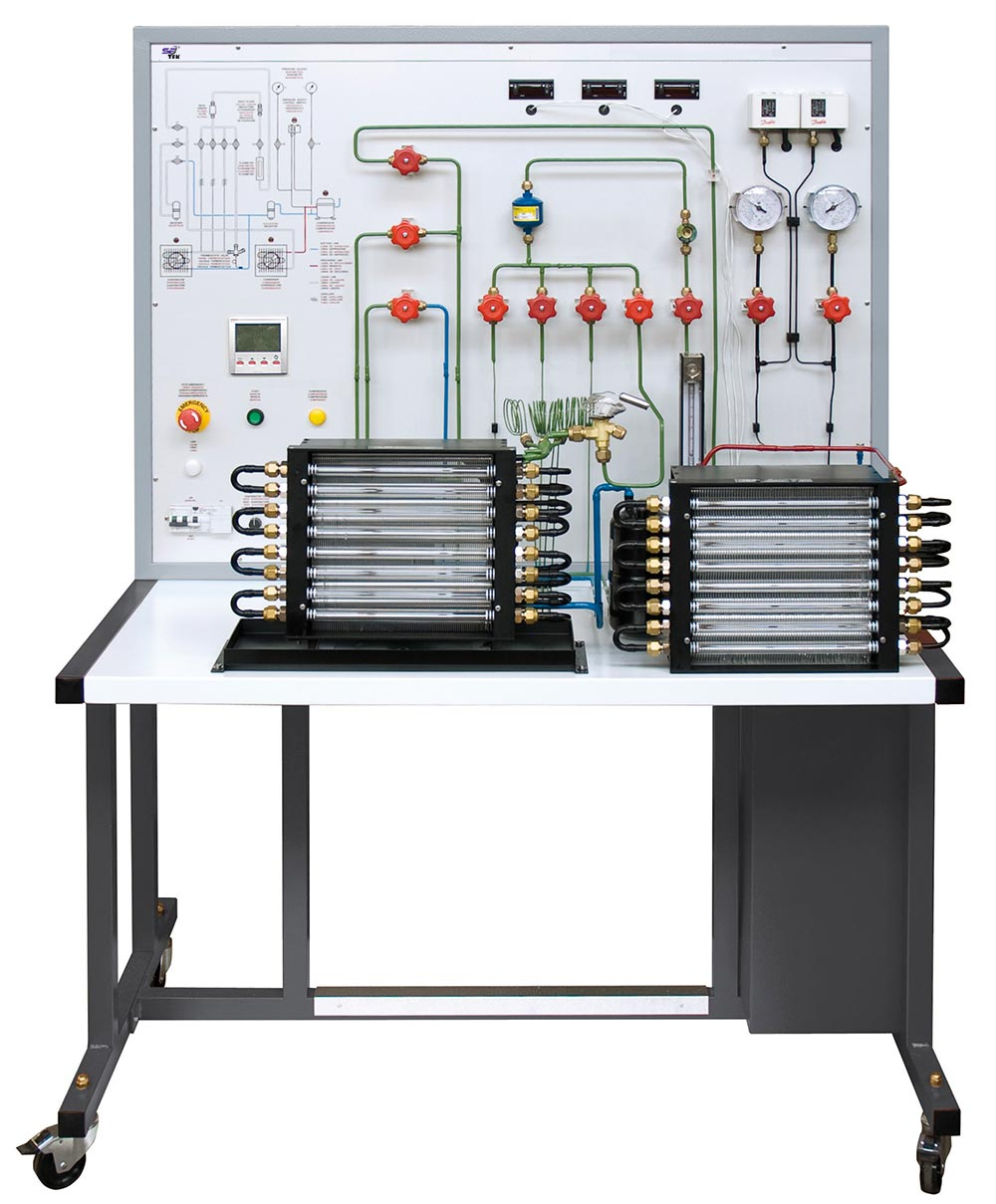
Product Description: This trainer is designed for the in-depth study of vapor compression cycle. It enables to vary the load conditions of condenser and of evaporator, to use alternative devices for gas expansion, to handle successfully unexpected operating situations, such as the block of the refrigerant flow or a wrong gas charge inside the circuit. Students can become familiar with the refrigerant pressure-enthalpy diagram and evaluate the heat balances corresponding to the different cycle components, by using the set of industrial instruments of the equipment.
Technical Specification:
? Steel structure mounted on wheels, painted and treated in the oven.
? Color silk-screen-printed schematic diagram of the hydraulic circuit with warning LEDs.
? Hermetic compressor.
? Forced-air condenser with variable flow settable by potentiometer, equipped with 8 glass pipes for displaying the refrigerant condensation process.
? Forced-air evaporator with variable flow settable by potentiometer, equipped with 8 glass pipes for displaying the refrigerant evaporation process.
? Devices for liquid lamination: internal equalization thermostatic valve, 3 capillary tubes of different geometry.
? Liquid receiver, liquid separator.
? On-off valves, sight glass, dehydrator filter.
? Valve for plant vacuum, refrigerant charging and recovering.
? Pipes connecting the various components painted with different colors.
? Full set of instruments for data acquisition, including: Flowmeter, High- and low-pressure gauges.
? 3 electronic thermometers with Pt100 probes to be inserted into several test points along the hydraulic circuit.
? Digital multimeter.
? High- and low-pressure switches.
? Thermomagnetic – earth leakage control button.
? Emergency button.
? Weight: 120 kg.
? Dimensions: 1550 x 750 x 1800 mm.
Learning Outcomes:
? Plant starting and safety devices intervention checking.
? Studying the operation of a thermostatic expansion valve.
? Analyzing the system behavior versus the variation of: Expansion device. Superheat (when the thermostatic expansion valve is used). Air flow rate at condenser and/or evaporator. Refrigerant charge into the system.
? Plotting the cycle in the refrigerant pressure-enthalpy diagram.
? Data acquisition and calculation of: Thermostatic valve superheat. Heat balances corresponding to evaporator, condenser, compressor. Refrigerant mass flow. Ideal and actual EER. Volumetric compression efficiency.
? Troubleshooting of system and of its components.