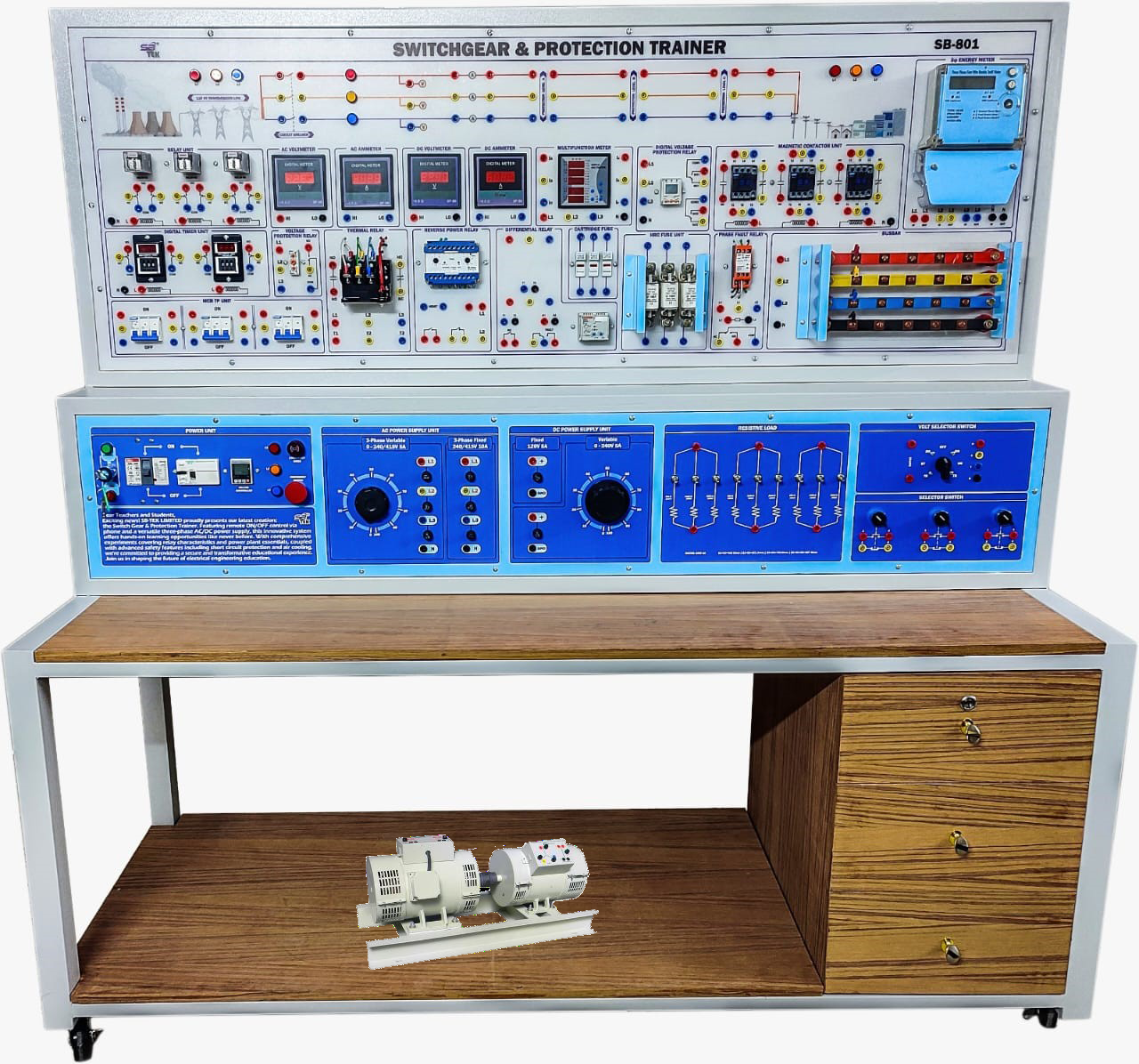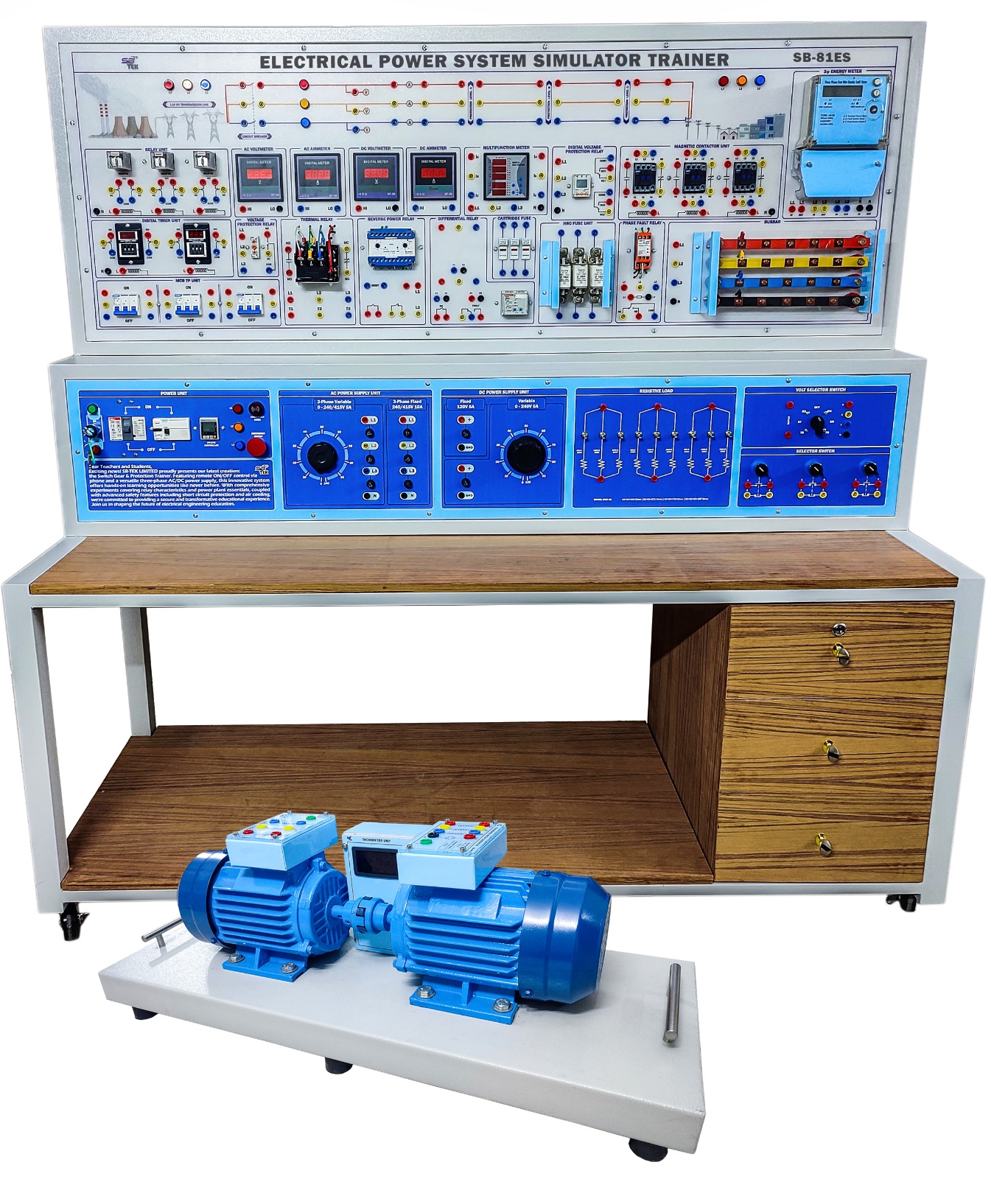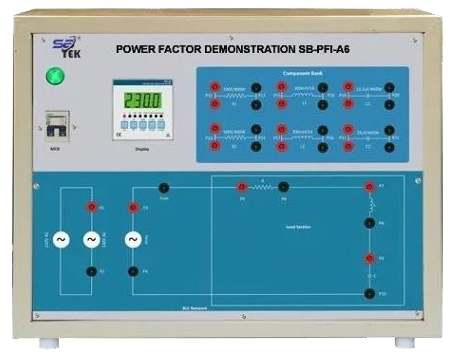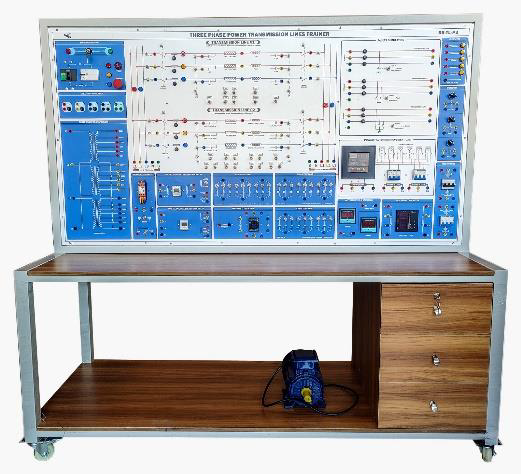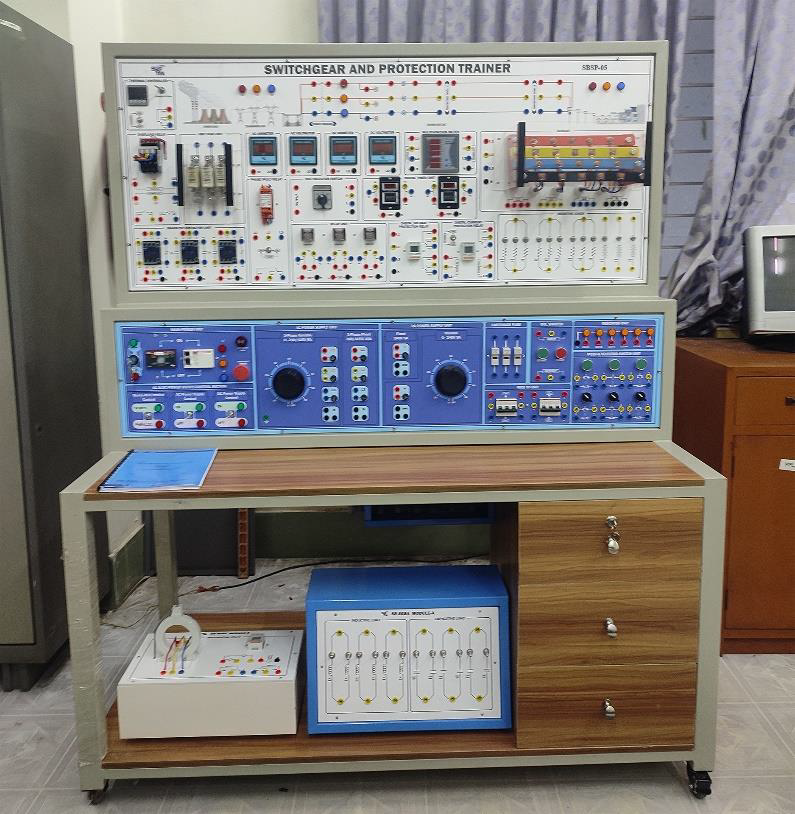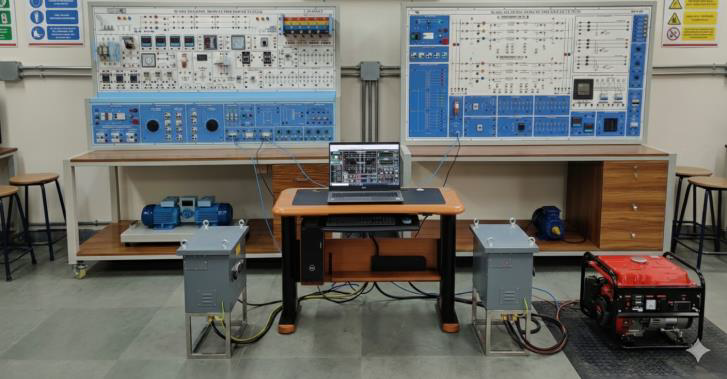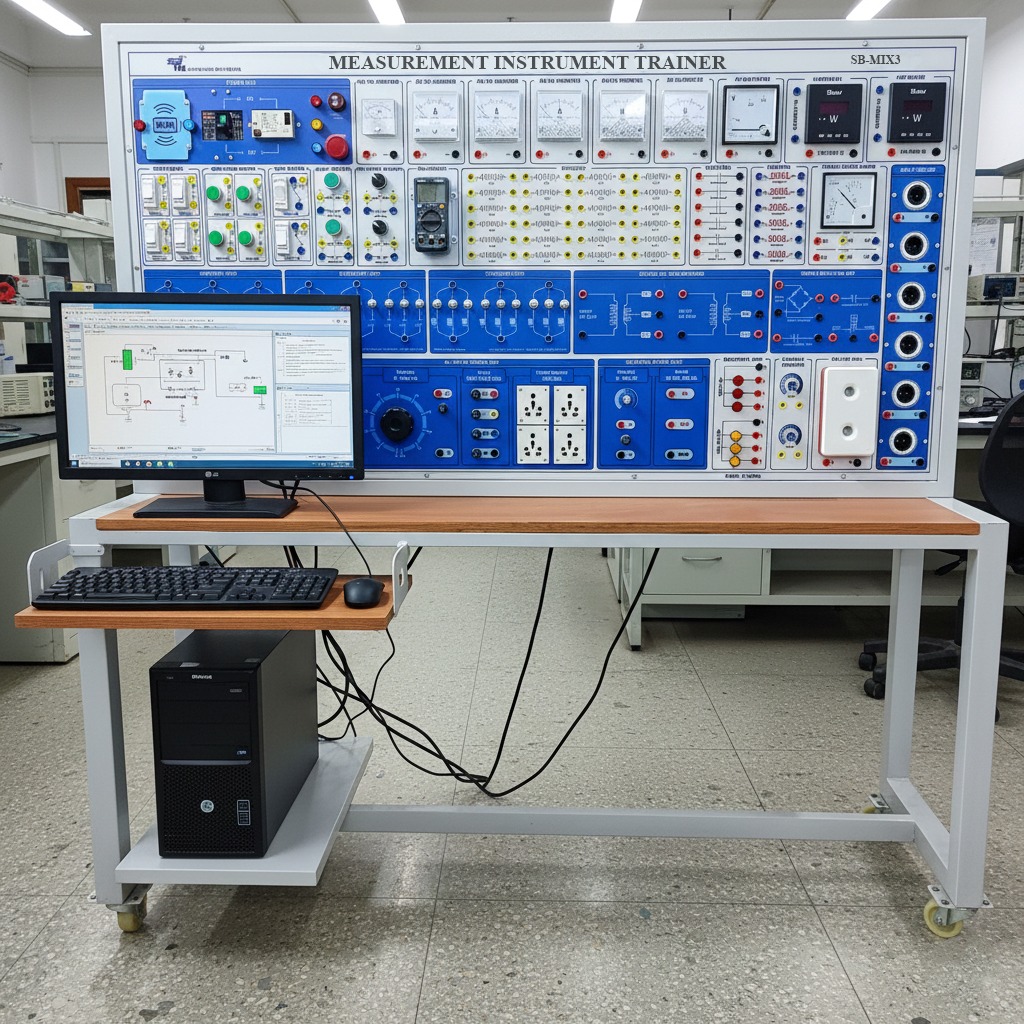
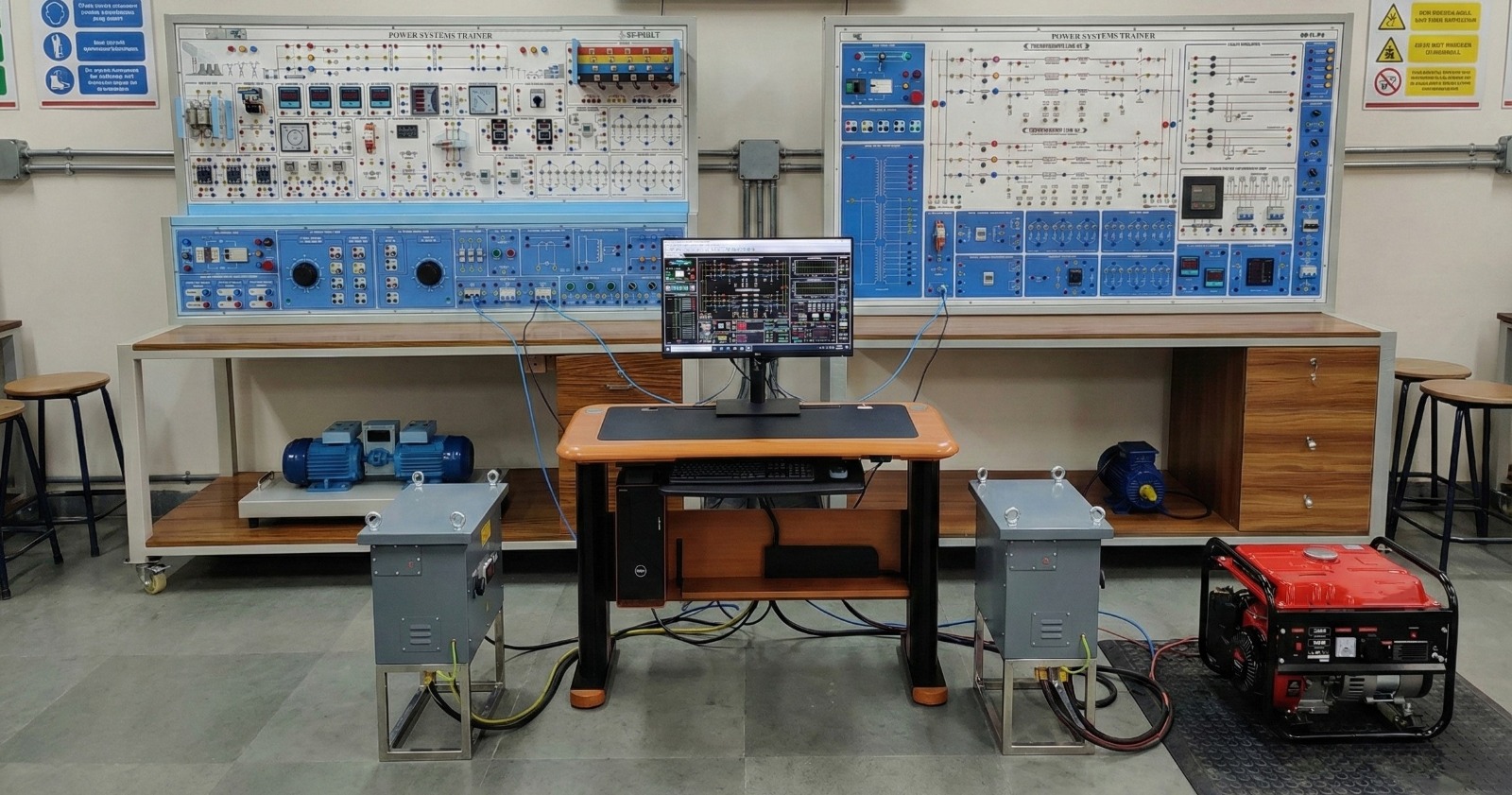
OVERVIEW: The SB-PX3 Power Systems Trainer from SB-TEK is a self-contained, SCADA-supervised laboratory system that simulates the complete operation of an electrical power system — from generation to transmission, transformation, distribution, utilization, and protection. Developed in strict compliance with the latest European Union Directives (CE, EMC, LVD, RoHS), the SB-PX3 incorporates industrial-grade European-brand relays, breakers, and analyzers, offering students, researchers, and professionals a real-world experience in power system operation and protection. The system is fully integrated with ASCDA (Advanced SCADA Software Suite), providing real-time monitoring, data logging, switching, event recording, and protection relay configuration through an intuitive graphical interface.
KEY FEATURES:
Complete power system simulation: generation, grid supply, transmission, transformation, distribution, utilization.
Industrial-standard protection relays: from ABB, Siemens, and Schneider Electric.
SCADA-supervised operation: with single-line diagram (SLD) interface, relay configuration, fault logging, and event playback.
Real-time data acquisition: voltage, current, frequency, power factor, harmonic distortion, breaker status, relay trip/alarm status.
Integrated fault creation: single-line, double-line, three-phase, and earth faults with programmable duration.
Synchronization studies: generator-to-grid, phase angle, frequency, and voltage matching.
Load banks: resistive, inductive, capacitive, and dynamic (motor) loads.
Inbuilt safety system: emergency stop, interlocks, and fault alarms.
SYSTEM SPECIFICATIONS:
Generation & Grid Supply
Prime Mover: 7 kVA induction motor with four-quadrant vector drive and shaft encoder.
Generator: 6 kVA synchronous generator, 4-pole, brushless, with manual/automatic excitation.
Generator Transformer: Delta-Star (Dy11), 1:1 ratio, impedance matched, with adjustable taps.
Grid Transformer: 5 kVA, Delta-Star (Dy11), primary matched to mains, secondary 220V 3-phase.
Synchronization Unit: Synchroscope and Siemens 7VE61 synchronization relay.
Transmission Lines:
• Seven simulated line sections (per-unit impedances 0.1–0.25 pu, cable & overhead models).
• Fault switches (manual and timed) for applying line-to-line, line-to-ground, and three-phase faults.
• Test sockets for oscilloscope/SCADA measurement at multiple points.
• Capacitor banks for long-line and Ferranti effect studies.
Distribution & Utilization
Twin 2 kVA distribution transformers with adjustable taps, Star–Delta (Yd1).
Switched Busbar:
Main and reserve bus, six bi-directional feeders with motorized circuit breakers.
One feeder equipped with point-on-wave switching (via SCADA timing).
Inter-bus coupler breaker for double-bus operation.
Utilization Bus:
Variable resistive, inductive, capacitive loads (delta-connected).
Dynamic load: 1.5 kW squirrel-cage induction motor.
Protection Devices:
(All relays and breakers are industrial-standard, EU-certified, from leading European brands.)
Generator Protection:
ABB REG670:
Functions: Overcurrent, Differential, Over/Undervoltage, Over/Underfrequency, Loss of Excitation, Reverse Power, Rotor Earth Fault.
Grid Transformer Protection:
Schneider Micom P642:
Functions: Restricted Earth Fault (REF), Differential, Overcurrent Backup.
Transmission Line Protection:
Siemens 7SA82:
Functions: 3-Zone Distance, Overcurrent, Power Swing Blocking, Fault Locator.
Distribution Feeder Protection (Six Feeders)
Siemens 7SJ64:
Functions: Numerical Overcurrent & Earth Fault Protection, Directional Control, Breaker Failure Protection.
Circuit Breakers & Switchgear:
Motorized Circuit Breakers:
Siemens 3WL Air Circuit Breakers.
ABB VD4 Vacuum Circuit Breakers (selected feeders).
Isolators/Disconnectors: ABB OT Series with mechanical interlock.
Auxiliary Protection: Schneider Acti9 MCBs.
Other Protection & Measurement Devices:
Siemens 7VE61 Synchroscope & Synchronization Relay.
Siemens 7RW80 Under/Overvoltage & Frequency Protection Relay.
Schneider ION9000 Power Quality Analyzer (integrated with ASCDA).
Siemens DIGSI / SICAM Fault Recording & Event Logger (integrated with SCADA).
PC Configuration for SCADA Workstation:
Processor (CPU): Intel Core i7-11700 or i7-11700K (8 cores / 16 threads, up to 5.0 GHz Turbo).
Motherboard / Chipset: Intel 500-series (e.g., B560, H570) or 400-series (Z490, B460) with LGA 1200 socket; supports PCIe 4.0 (if available), multiple PCIe slots, M.2 NVMe slot, and dual LAN.
RAM (Memory): 32 GB DDR4-3200 (2 × 16 GB modules, dual channel), expandable up to 64 GB.
Storage: 1 TB NVMe PCIe SSD (dedicated for SCADA software, database, logs, and replay files).
Monitor: 27? IPS monitor, Full HD (1920 × 1080) or higher resolution, wide-viewing angle; recommended dual-monitor setup for SCADA mimic diagrams and event logging.
SCADA Integration (ASCDA Software Suite):
The SB-PX3 comes with a dedicated SCADA software package offering:
Single-Line Diagram (SLD) GUI: with live status of CBs, isolators, relays, and buses.
Relay Communication: via IEC 61850, Modbus TCP/IP, and IEC 60870-5-104.
Event & Fault Recorder: with timeline playback (relay trips, breaker operations).
Trending & Analysis: Real-time plots of V, I, f, PF, THD, harmonic analysis.
Fault Simulation: Trigger line, bus, transformer, or generator faults directly from SCADA.
Protection Relay Configuration: Set thresholds, curves, time delays, and observe relay response.
Power Quality Monitoring: Voltage dips, swells, flicker, harmonics (via Schneider ION9000).
User Management: Role-based access for students, instructors, and administrators.
Data Logging: Export to CSV, Excel, or SQL database for research.
Learning Outcomes:
• Operation and synchronization of synchronous generator with grid.
• Transmission line behavior under normal and fault conditions.
• Distance protection, fault location, and power swing blocking.
• Transformer differential and earth fault protection.
• Bus switching and feeder protection schemes.
• Load flow analysis, voltage regulation, and stability studies.
• Real-time SCADA monitoring and control of protection systems.
• Fault recording and analysis for post-fault diagnosis.
• Power quality monitoring and harmonic analysis.
Standard Features
• Modular, compact console design with EU safety compliance.
• Supplied with comprehensive experimental manual
• Equipped with emergency stop, interlocks, and audible alarms.
• Mounted on heavy-duty wheels for mobility.
• Fully compliant with CE / EMC / LVD / RoHS Directives.