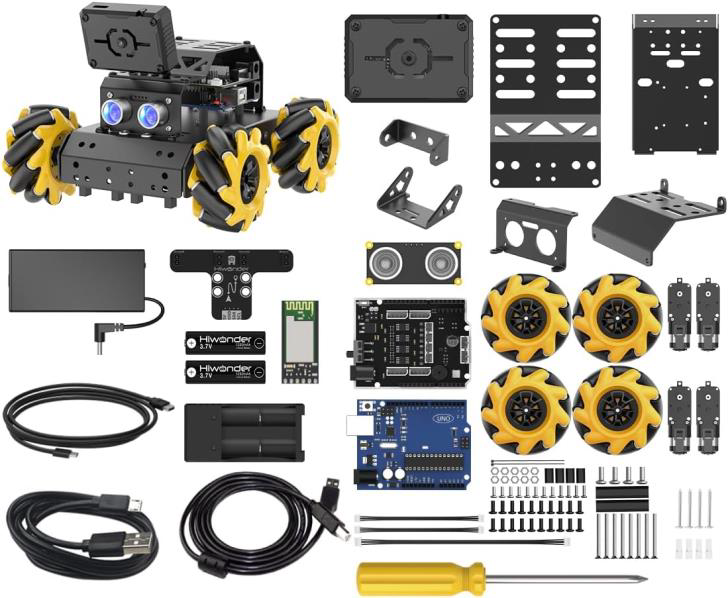
PRODUCT OVERVIEW: The SB-TEK SB-ROBO-AL1 is an educational and research-grade autonomous line-following robot designed for engineering universities, robotics labs, and AI training environments. It integrates precision sensing, PID-based motion control, optional AI capabilities, and robust mechanical design, making it ideal for experiments in robotics, embedded systems, and autonomous navigation. The system is optimized for reliability, simplicity, and high-performance line tracking on various surfaces.
TECHNICAL SPECIFICATIONS
Hardware Components
Chassis:
The robot is built on a durable acrylic or 3D-printed base and supports both 2WD (Differential Drive) and 4WD configurations, allowing flexible experimentation for students and researchers.
Motors:
It uses two geared DC motors rated between 100–300 RPM. Optional motor encoders may be integrated for closed-loop speed control and advanced navigation.
Sensors:
The system includes five IR reflective sensors (TCRT5000) for accurate line detection and high-precision path recognition. An ultrasonic sensor (HC-SR04) may be added optionally to enable obstacle detection and avoidance during autonomous movement.
Control Unit:
The robot can be controlled by an Arduino Uno or ESP32 microcontroller. Motor actuation is handled through either an L298N or L293D motor driver module.
Power Supply:
The power system includes a 7.4V Li-ion (2S) rechargeable battery pack with a regulated 5V output for logic-level electronics.
Software & Algorithms
Line Detection:
A PID control algorithm is implemented to achieve smooth line tracking, with tunable Kp, Ki, and Kd parameters for precise error correction. Threshold calibration is provided to adapt sensor response for different line colors and surface contrasts.
Optional AI Integration:
The system can be upgraded with advanced computer vision using OpenCV and a Raspberry Pi module. Reinforcement Learning (Q-Learning) may also be integrated to support adaptive and intelligent control behaviors.
Performance Metrics:
The robot achieves a maximum speed of 0.3–0.5 m/s depending on the motor configuration. It supports line widths between 15 mm and 25 mm and operates effectively on black-on-white or white-on-black tracks. These metrics ensure reliable performance in academic and research environments.
EXPERIMENT NAME:
Tasks
Hardware Assembly: Students assemble the chassis, mount motors, IR sensors, ultrasonic sensor, motor driver, and microcontroller, and verify motor rotation and sensor response.
Sensor Calibration: IR thresholds are adjusted to ensure accurate detection of the track under different lighting or surface conditions.
Basic Line Following (ON/OFF Control): A simple left-right logic approach is used to demonstrate fundamental line-tracking behavior.
PID Tuning for Smoother Motion: Kp, Ki, and Kd parameters are implemented and calibrated to achieve smooth, stable line following.
Advanced Features (Optional): Students may integrate junction detection (90° turns, T-sections), obstacle avoidance using ultrasonic sensors, or combined line tracking with intelligent decision-making.
Expected Outcomes
The robot autonomously follows a predefined track with high accuracy. Students gain practical insight into PID vs. ON/OFF control, understanding how different algorithms influence motion quality. The robot can navigate curves, small gaps, and track intersections depending on tuning and configuration.
Included Accessories (Optional)
• Pre-designed black/white track
• Sample Arduino PID control code
• Troubleshooting and calibration guide
Installation & Training
SB-TEK provides free installation, operation, commissioning, and maintenance training at the purchaser’s laboratory site. The training ensures students and instructors can effectively use and maintain the robot.
Documentation Requirements provided original product catalogue, user manual, and product description manual as part of the delivery.